Introduction
Nukleotidy, more commonly known in English as nucleotides, are among the most essential molecules in all living organisms. They serve as the fundamental building blocks of DNA and RNA, the molecules responsible for storing and transmitting genetic information. Without nucleotides, life as we know it would not exist.
From determining your eye color to enabling cells to produce energy, nucleotides play a critical role in nearly every biological process. This article explores what nukleotidy are, their structure, functions, history, and why they are so important in biology, medicine, and biotechnology.
What Are Nukleotidy?
Nukleotidy are organic molecules that form the structural units of nucleic acids—DNA (deoxyribonucleic acid) and RNA (ribonucleic acid). They are often described as the “letters” of the genetic alphabet.

Hashtags:
#Nukleotidy #Nucleotides #MolecularBiology #Genetics #DNA #RNA #Biotechnology #CellBiology #LifeSciences #GeneticResearch #ScienceEducation #BioScience #NucleicAcids #ATP #GeneExpression #BiologyFacts #DNAResearch #MedicalScience #BiotechnologyInnovation #STEMEducation
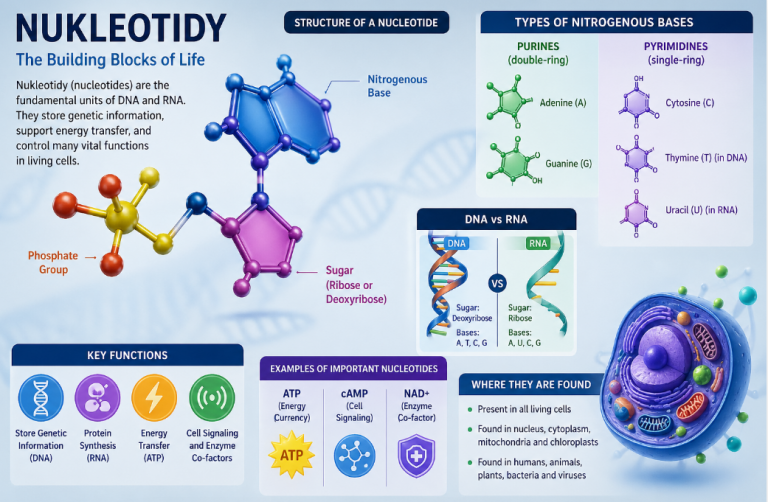
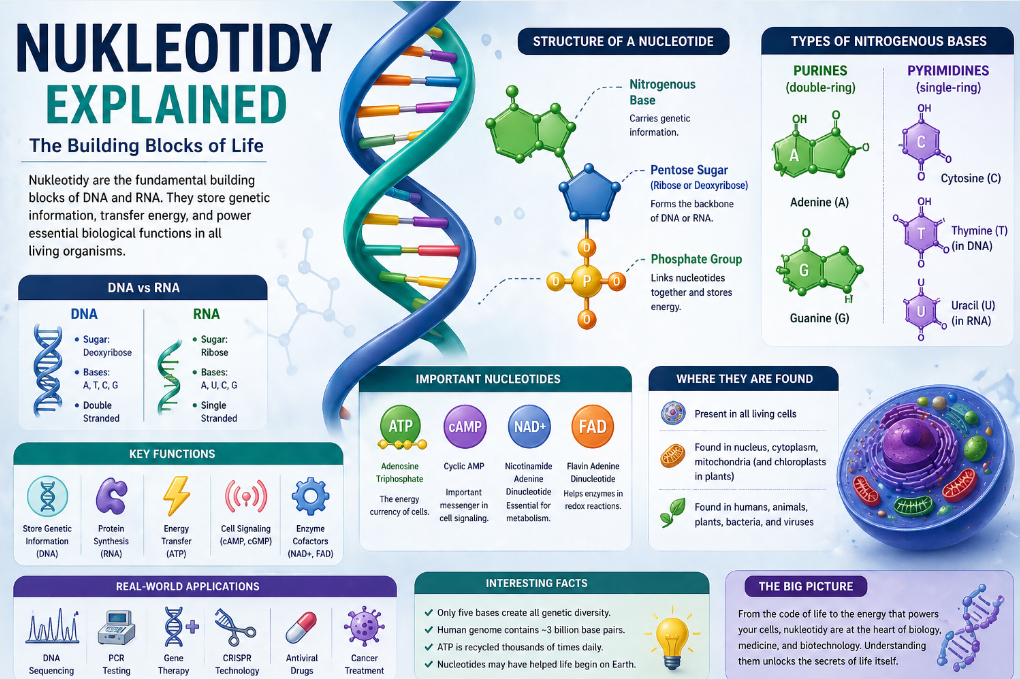
Each nucleotide consists of three essential components:
- A nitrogenous base
- A five-carbon sugar
- One or more phosphate groups
When linked together, nucleotides form long chains that make up DNA and RNA molecules.
Basic Structure of a Nucleotide
The structure of a nucleotide is simple yet highly efficient. Each part has a specific role in maintaining genetic integrity and supporting cellular functions.
| Component | Description | Primary Function |
|---|---|---|
| Nitrogenous Base | Adenine, Guanine, Cytosine, Thymine, or Uracil | Encodes genetic information |
| Pentose Sugar | Ribose or Deoxyribose | Forms the structural backbone |
| Phosphate Group | One or more phosphate units | Links nucleotides together and stores energy |
Types of Nitrogenous Bases
Nucleotides contain five primary nitrogenous bases, divided into two categories.
Purines
Purines have a double-ring structure:
- Adenine (A)
- Guanine (G)
Pyrimidines
Pyrimidines have a single-ring structure:
- Cytosine (C)
- Thymine (T) – found in DNA
- Uracil (U) – found in RNA
Nukleotidy in DNA and RNA
DNA and RNA both rely on nucleotides, but they differ slightly in composition.
DNA Nucleotides
DNA contains:
- Adenine
- Thymine
- Cytosine
- Guanine
The sugar in DNA is deoxyribose.
RNA Nucleotides
RNA contains:
- Adenine
- Uracil
- Cytosine
- Guanine
The sugar in RNA is ribose.
This small difference allows RNA to perform unique roles in protein synthesis and gene regulation.
How Nukleotidy Form DNA and RNA
Nucleotides join together through phosphodiester bonds, creating long chains called polynucleotides. In DNA, two complementary strands twist together to form the famous double helix.
Base pairing follows specific rules:
- Adenine pairs with Thymine (or Uracil in RNA)
- Cytosine pairs with Guanine
These pairings ensure accurate storage and replication of genetic information.
Main Functions of Nukleotidy
Nucleotides are not limited to genetics. They perform several critical roles in living cells.
Genetic Information Storage
DNA nucleotides store hereditary instructions that determine an organism’s traits and functions.
Protein Synthesis
RNA nucleotides help convert genetic information into proteins, which perform most cellular activities.
Energy Transfer
ATP (adenosine triphosphate) is a nucleotide that serves as the primary energy currency of cells.
Cell Signaling
Cyclic nucleotides such as cAMP and cGMP act as intracellular messengers.
Enzyme Support
Several coenzymes, including NAD+, FAD, and Coenzyme A, are derived from nucleotides.
ATP: The Energy Molecule
ATP is one of the most important nucleotides in biology. It stores and transfers energy needed for essential cellular processes.
ATP powers:
- Muscle contraction
- Nerve impulse transmission
- Active transport
- Cellular metabolism
- Protein synthesis
Without ATP, cells would be unable to function.
Nucleoside vs. Nucleotide
These terms are often confused, but they are not the same.
| Feature | Nucleoside | Nucleotide |
|---|---|---|
| Nitrogenous Base | Yes | Yes |
| Sugar | Yes | Yes |
| Phosphate Group | No | Yes |
A nucleotide is simply a nucleoside with one or more phosphate groups attached.
History of Nukleotidy Discovery
The discovery of nucleotides revolutionized biology.
Key Milestones
- 1869: Friedrich Miescher discovered “nuclein,” later identified as DNA.
- Late 1800s: Albrecht Kossel identified the nitrogenous bases.
- Early 1900s: Phoebus Levene described the nucleotide structure.
- 1953: James Watson and Francis Crick revealed the DNA double helix structure.
These discoveries laid the foundation for modern genetics and molecular biology.
Where Are Nukleotidy Found?
Nucleotides are found in every living organism, including:
- Humans
- Animals
- Plants
- Bacteria
- Viruses
They are present in:
- Cell nuclei
- Cytoplasm
- Mitochondria
- Chloroplasts (in plants)
SEO Tags:
nukleotidy, nucleotides, nukleotidy explained, what are nucleotides, nucleotide structure, DNA and RNA, genetic building blocks, nucleotide function, ATP, molecular biology, genetics, DNA structure, RNA structure, nucleic acids, cell biology, biotechnology, gene expression, nucleotide types, purines and pyrimidines, biological molecules
Medical and Biotechnological Applications
Nucleotides have transformed medicine and biotechnology.
Common Applications
- DNA sequencing
- PCR testing
- Genetic engineering
- Gene therapy
- CRISPR technology
- Antiviral medications
- Cancer treatments
These innovations continue to improve healthcare and scientific research.
Role in Evolution
Many scientists support the “RNA World Hypothesis,” which suggests that RNA molecules were the first self-replicating systems on Earth.
This theory proposes that nucleotides were among the earliest molecules to support life, making them central to the origin of biological evolution.
Why Nukleotidy Matter in Everyday Life
Although invisible to the naked eye, nucleotides influence nearly every aspect of your body, including:
- Eye color
- Hair texture
- Height
- Metabolism
- Immune response
- Inherited traits
Every human genome contains approximately three billion base pairs, all built from nucleotides.
Interesting Facts About Nukleotidy
- Only five bases are needed to encode all genetic information.
- Human DNA contains about 3 billion base pairs.
- Cells recycle ATP thousands of times each day.
- Nucleotides are essential for both heredity and energy metabolism.
The Future of Nucleotide Research
Emerging technologies based on nucleotide science include:
- Personalized medicine
- Synthetic biology
- DNA data storage
- Advanced gene editing
- Precision diagnostics
These innovations are shaping the future of medicine, agriculture, and technology.
Conclusion
Nukleotidy are the molecular foundation of life. They store genetic information, fuel cellular processes, and enable the transmission of hereditary traits. Their importance extends far beyond DNA and RNA, influencing energy production, signaling pathways, and countless biological functions.
Understanding nucleotides provides valuable insight into how life works at the molecular level. As research continues, these remarkable molecules will remain at the heart of scientific discovery and medical advancement.
Hashtags:
#Nukleotidy #Nucleotides #MolecularBiology #Genetics #DNA #RNA #Biotechnology #CellBiology #LifeSciences #GeneticResearch #ScienceEducation #BioScience #NucleicAcids #ATP #GeneExpression #BiologyFacts #DNAResearch #MedicalScience #BiotechnologyInnovation #STEMEducation
About the Author